

renting the fire alarm
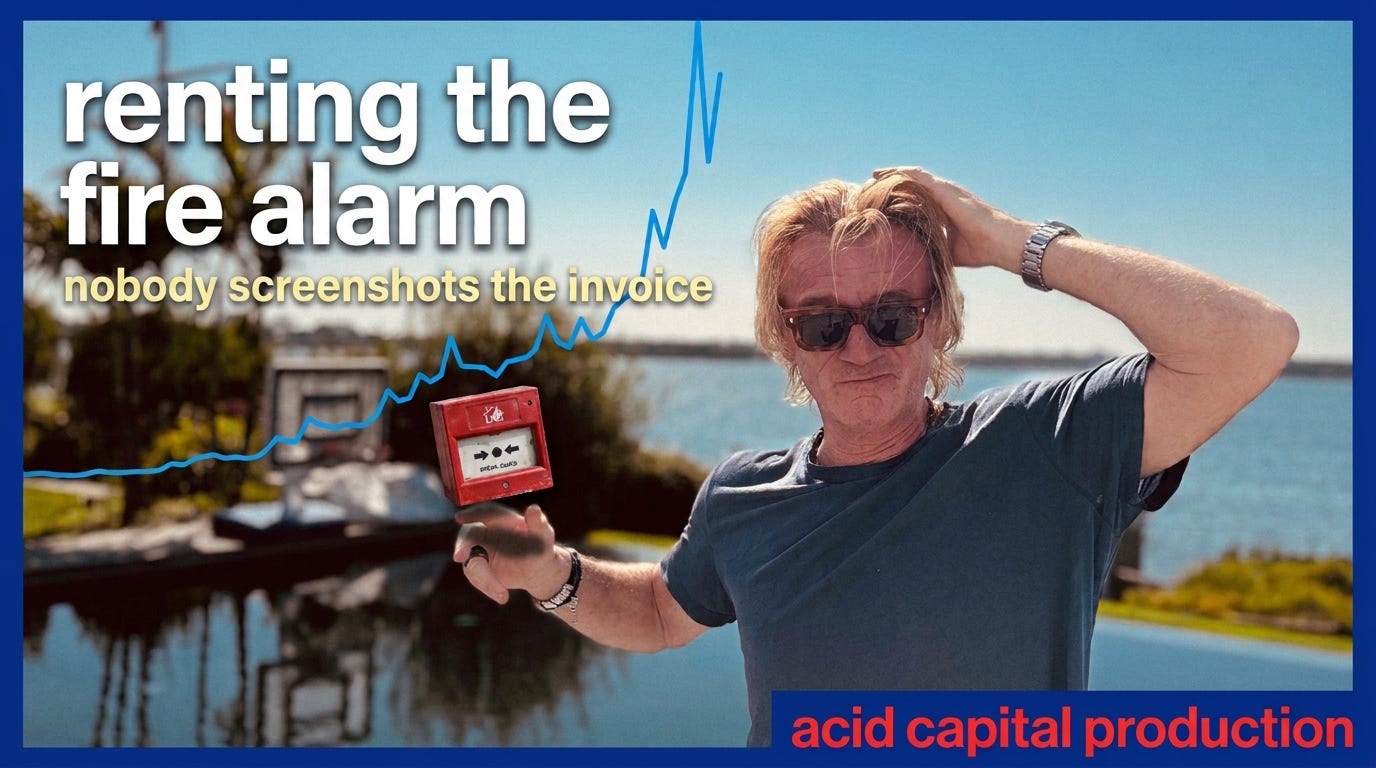
wall street is paying a fortune to insure against the collapse of artificial intelligence. i’ve spent years buying precisely this kind of protection. the lesson was expensive, and it makes me suspicious of what the market thinks it’s telling us.
somewhere tonight a sensible man is sitting on the newest and dearest version of his own fear, paying close to a tenth of the sum insured each year to be told what the newspaper already told him. he’ll roll it again in march, and again in september, until the alarm goes quiet and he notices that the only thing that ever burned was his premium.
i’ve been that man, and i can tell you that being right about a catastrophe is a rather different business from making money out of one. which is why the extraordinary sums being paid to insure against the collapse of artificial intelligence interest me rather more than the collapse itself. the market is presenting its alarm bill as evidence that the building is about to burn. i suspect it’s confusing the price of fear with the probability of disaster.
three letters have wandered back into polite company, and this month they’re being pronounced with the hushed relish people reserve for a diagnosis that belongs to somebody else. the letters are c-d-s, and the financial times reckons that whenever they appear in a sentence, something bad is happening.
in my experience the bad thing is the bill. cds stands for credit default swaps, which are insurance on a loan. the buyer pays an annual premium on the amount insured and the seller pays out if the borrower defaults. the premium is quoted in basis points, hundredths of a percentage point. on 15 october the 5-year contract on coreweave, the artificial intelligence (ai) cloud builder the market most loves to fear, touched a record 1,194 basis points intraday before settling near 1,038, almost 3 times the 368 it fetched on 6 october 2025. at that level, insuring $10m of its debt costs about $1,038,000 a year, like paying a tenth of what your house is worth, every year, to insure it. if coreweave defaults, the seller would most likely owe $6m, the $10m less the average 40% the market assumes bondholders recover.
the chart 👇 everybody is passing around shows the movement in spreads. it doesn’t show what it cost to hold the position. it plots the on-the-run contract, the freshly minted 5-year issue where the liquidity rests, and the risk manager will insist the book stays there. that’s where the liquidity exists if you need to sell. so the trader keeps selling the (cheaper) contract he owns, which has aged, and buying the new (more expensive) one. on the normal upward-sloping credit curve the aged contract is worth less than the new one, so he has to keep selling cheap and buy dear. the dealer, naturally, takes a cut on both legs. when i was paying for it the ritual ran every quarter. it runs every half-year now, which changes nothing, because the contract ages just as fast. the cost is horrible and largely invisible. commodity traders know the same disease as contango, the condition in which the next future costs more than the one expiring, and the exchange-traded funds that hold US natural gas futures have spent years showing how a correct view on direction gets eaten alive by the cost of staying in the trade. i wrote about it on my substack in march 2024, when i was bullish on gas and still begged readers never to buy the etf, preferring to sell call spreads against it and let the roll do the work, and the etf has kept falling the way i said it would, it’s the same plumbing, and paid subscribers can read the original here: sell natural gas fund
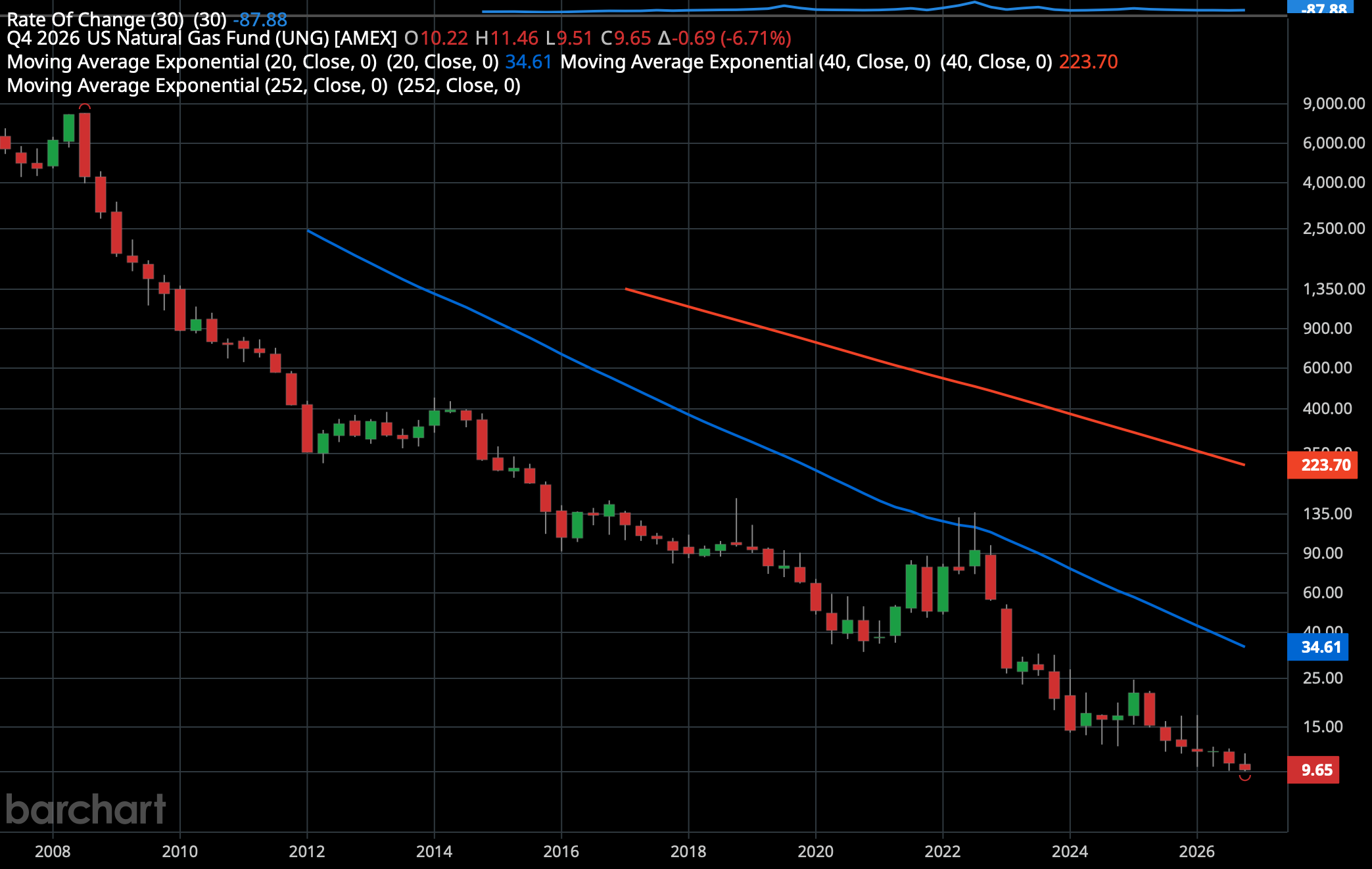
source: barchart. acid capitalist. united states natural gas fund lp
run the meter through a quiet cds year and the cost is uglier than the premium the brochure quotes. on an investment-grade name quoted near 30 basis points, where the premium itself is a rounding error, a year in which nothing happens still costs somewhere between 2.5% and 4% of the amount insured once roll-down and the dealers’ cut are counted. on a name quoted around 650, roughly where coreweave sat through much of last winter, a buyer who watched spreads go precisely nowhere for 12 months would have handed over something between 7% and 11%. that’s a policy shedding close to a tenth of its value every year the house declines to burn. the screenshot shows none of it, because nobody screenshots the invoice.
i know the sound of that meter because i listened to it for 2 or 3 years. from 2010 my eclectica credit fund ran a huge position buying protection on japanese cyclical companies, on the view that china would slow and begin exporting its surplus capacity into the rest of asia. china didn’t slow. the fund was a genuine diversifier in the periodic months of crisis back then and a very miserable thing to own the rest of the time, because the cost of all that insurance dragged it into a drawdown of roughly 30%. when i judged that the prospect of a chinese slowdown was ebbing, i closed it. the export of surplus capacity i was paying to insure against is more or less what my last essay described, arriving long after my policy lapsed, which is the distance between being right and being paid, measured in rolls.