

the family in lagos who lends to washington.
i’ve spent much of my adult life worrying about who the hell is going to finance america’s debts. the chinese? the japanese? some poor bastard at the federal reserve condemned to pressing the print button until his finger falls off?
turns out i may have been looking in entirely the wrong place.
meet the family in lagos. they’ve never heard of an american treasury bill. they couldn’t tell you what the federal reserve did at its last meeting, and they’d probably tell washington to fuck off if it arrived asking for a loan. but here’s the wonderful thing. they’re lending it money anyway. nobody asked them. nobody told them. they simply wanted to stop their own government robbing them.
and there’s my latest obsession. the world’s greatest debtor has discovered a new creditor, and the creditor doesn’t even know it’s a creditor. somewhere between a Nigerian kitchen table and the United States Treasury stands an Italian former plastic surgeon making a fortune from the arrangement. i’ve spent 30 years in global macro, and i still find myself laughing at the sheer audacity of it.
welcome to the dollar empire. the sequel’s better than the original.
start with the crime, because there’s always a crime. western financial elites have spent decades selling us the emerging-market growth miracle. look at the superior GDP growth, they say. surely the stock market must outperform? but growth isn’t a return on your investment. it’s only a return if somebody lets you keep it. and in too many emerging markets, the proceeds are captured by insiders while governments quietly confiscate what’s left through the currency. wall street gets its fees. the local elites get richer. the ordinary saver gets the miracle. just not the money.
nigeria is an oil and agricultural producer, not some barren country waiting for the world to discover it. africa’s largest crude-oil producer, sitting on something the entire planet has spent a century fighting over. in 1995 a barrel of brent cost about $17. by 2025 it averaged $68. oil went up 4 times. the naira went from 22 to roughly 1,333 to the dollar. and here’s the number that ought to make you spit out your coffee. in 2025, interest payments swallowed more than half the government’s revenue. economists call the punishment inflicted on savers financial repression. i call it a tax on prosperity. a pox on the good folk. the country’s sitting on black gold, and its citizens are buying dollars on their phones to escape the national currency.
and when the citizens finally find a way to escape, the authorities go after the escape route. nigeria restricted banks from dealing with crypto businesses, then pursued the exchanges as the naira continued its descent. the government had spent years undermining confidence in its own currency, yet somehow the villains were the people offering an alternative. the finance minister will have an explanation, of course. finance ministers always have explanations. blah-blah is their principal export.
when the thermometer shows a fever, arrest the thermometer.
now here’s where things become gloriously absurd. those dollars on the phone aren’t quite dollars. they’re stablecoins, digital tokens designed to hold the value of a dollar, and the biggest is issued by tether. at the centre of this extraordinary enterprise is giancarlo devasini, an italian former plastic surgeon who moved into selling computer equipment before discovering crypto. i couldn’t have invented him. he’s now chairman of a company that, at the end of september, reported $132bn in direct and indirect exposure to american treasury bills.
think about that career change. you’re trained to make ladies’ boobies larger and to improve people’s faces and end up helping to finance the united states government. most people would settle for a successful medical practice. giancarlo appears to have stumbled upon the monetary equivalent of discovering oil beneath the bathroom floor.
but the really interesting character in this story isn’t the plastic surgeon. it’s the family in lagos. they aren’t trying to make money from american government debt. they simply want the small pittance of money they’ve already earned to retain its value. tether sells them that promise: a dollar that won’t disappear overnight.
the family buys monetary refuge. tether buys america’s debt.
the distinction matters. when i ran a hedge fund, the great geopolitical anxiety was china. the preposterous existential: what happens if beijing stops buying treasuries? the question terrified commentators who imagined america waking one morning to discover that its principal creditor had walked out. the threat was always slightly ridiculous. china accumulated american government debt because doing so served china’s interests. not because beijing had developed a sentimental affection for washington.
indeed, china’s relationship with the dollar has always been rather more devious than the conventional story suggests. the renminbi remains managed, its capital account largely closed, and the prosperity of chinese households has too often been subordinated to the state’s determination to retain control. meanwhile beijing lends dollars to the world’s GDP poor / commodity-rich governments, securing dollar repayment against future export revenues. you scratch my back, i’ll keep you rascals in power. the arrangement became more hide and seek following the freezing of russian sovereign reserves after the invasion of ukraine. governments seeking to insulate themselves from western financial power have greater reason to cooperate clandestinely with one another than through the transparent treasury market.
think of them as a coalition of confiscators, united by their fear of the monetary freedom they deny their own people.
and here comes the extraordinary reversal. for decades, governments accumulated dollar assets while their citizens were trapped behind capital controls, watching their savings lose purchasing power. central banks bought american treasuries, which is to say they flogged their own currencies, because managing exchange rates served the political interests of the sovereign state. the dollars travelled to washington. the prosperity didn’t necessarily travel back to the households that helped create it.
now america has discovered something better than lending to the confiscators. it’s receiving capital from the confiscated.
and here’s the magnificent perversity. in dune, the empire depends on a desert planet called arrakis, whose sole claim to importance is that it produces the precious spice without which the imperial machine cannot function. well, america became china’s arrakis. the spice was the dollar liquidity. beijing needed an almost bottomless market for the dollars it was accumulating as it sold renminbi to frustrate the appreciation of its own currency. and washington, obligingly, supplied the deepest government debt market in human history.
think about the obscenity of that arrangement. the chinese state could deny its households the purchasing power their extraordinary productivity should have earned them, while using the dollar system to preserve an artificial competitive advantage against the manufacturers of the very country providing the financial infrastructure. america was producing the spice or maybe i should say deficits that helped its greatest economic rival game global trade. the chinese export machine needed the dollars to keep flowing. and the united states treasury was the great reservoir into which they flowed.
the spice must flow.
and here’s the part that makes my old macro brain fizz. the family in lagos has something extraordinary in common with the chinese state. neither came to the dollar system looking for an attractive bond yield. beijing needed a vast, liquid market for the dollars it accumulated while intervening to hold down its currency. the family needs a dollar it can hold beyond the reach of its own government. one used the system to frustrate the appreciation that should have enriched domestic households. the other uses it to escape the depreciation that has impoverished nigerian ones. neither is conducting a credit seminar on washington’s finances. but the proceeds find their way into american government debt, and there’s an italian former plastic surgeon in the middle collecting the interest on the family’s dollars.
try explaining that to somebody who thinks the treasury market is all about yield.
the family isn’t trying to become rich. it’s trying not to become poor. there’s a world of difference, particularly when you’re born into a country whose currency can confiscate years of accumulated labour without anyone having to enter your house.
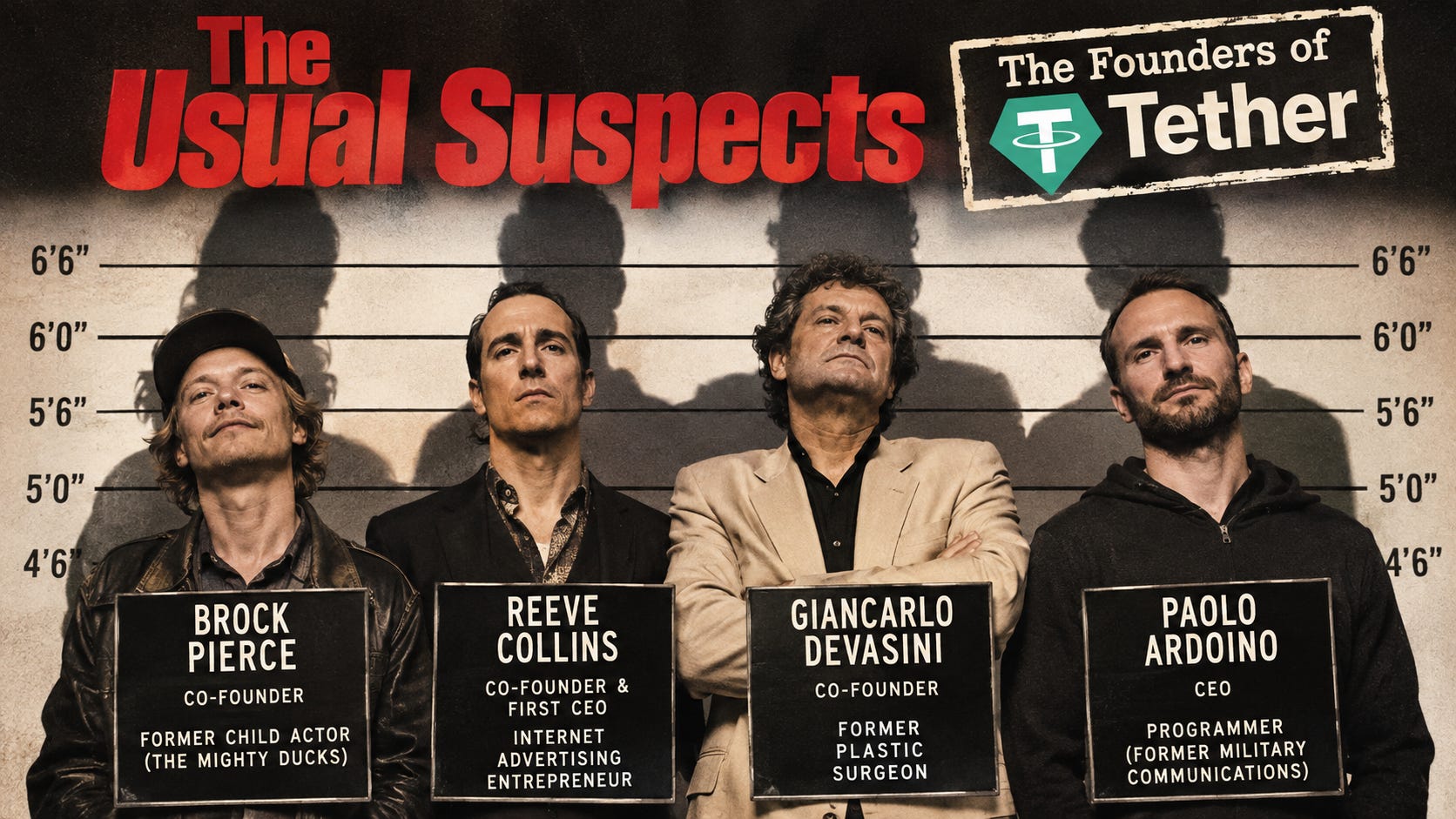
which brings me to the cast of characters. we’ve already met the italian plastic surgeon. but tether began with brock pierce, a former child actor from the mighty ducks, and reeve collins, a man who made his career selling advertising on the internet. then there’s paolo ardoino, today’s chief executive, an italian programmer whose earlier career included work on military communications. it’s the usual suspects, except somebody appears to have replaced the criminal mastermind with a disney child star.
and then, just when you think the plot cannot become any more ridiculous, a proper wall street banker enters the room. cantor fitzgerald, the firm once run by america’s commerce secretary howard lutnick, holds a substantial portion of tether’s treasury securities and has a reported 5% ownership interest. lutnick’s sons now run the firm. the plastic surgeon has found himself a very respectable american banker.
sometimes i look at tether and wonder whether i’ve stumbled across a cia operation. i’ve no evidence of one. but if langley had commissioned a scheme to extend the dollar’s reach into every country whose rulers denied their citizens monetary freedom, i’m not sure it could have improved on this one.
the currency adjustment that should have rewarded chinese households was frustrated by chinese policy, not by some mysterious failure of economics. and the same dollar architecture that could accommodate a state selling its own currency can now accommodate a citizen desperate to get rid of hers. beijing needed the immense depth of the dollar market. the family needs the dollar in its pocket. what a peculiar revenge on the gatekeepers of money. they built the walls. somebody else put a door in a telephone.
before the financial pedants start throwing their calculators at me, i know that every stablecoin transaction doesn’t conjure up a fresh buyer of american treasury bills. some merely shuffle existing dollars around. fine. that’s not the revelation. the revelation is that america has discovered a means of extending the reach of its currency without asking permission from governments that have spent decades restricting access to it. and washington didn’t have to invent the mechanism. a former plastic surgeon and his unlikely associates did much of the work.
the dollar doesn’t require anybody to love america. that’s what’s always fascinated me. beijing needed it to pursue an exchange-rate policy at the expense of its own consumers. the family needs it because the naira has been such a rotten store of what it earned. washington is not being rewarded for fiscal virtue. it owns the liquid monetary territory both need, for opposite purposes. the dollar was the reserve currency of governments. it’s becoming the escape currency of their citizens.
who is constrained, and how badly? i’ve always loved the economics of an american dollar hidden under a foreign mattress. washington issues the note and pays no interest. somewhere in the world, a family guards it as though it were treasure. the federal reserve estimated that foreigners held almost a trillion dollars of american banknotes in early 2021. imagine that. almost a trillion dollars lent to america by strangers who pay for their own security and never send an interest bill. perhaps the most extraordinary interest-free loan in financial history.
and now the smartphone arrives. not every digital dollar replaces a banknote, of course, but the economics of the new dollar are rather different. tether takes the money, invests a substantial portion in american treasury bills and pockets the yield. the family still doesn’t receive a penny of interest. only now somebody does. the plastic surgeon. the american government pays interest on its debt, and a private company earns the return on reserves backing the dollars that families hold for safety. america’s exorbitant privilege hasn’t disappeared. somebody has found a way to privatise a piece of it.
tether reported more than $10bn of net profit in 2025. extraordinary. the company has turned other people’s desperate search for a safe dollar into one of the great private financial franchises of our time.
there’s something about tether’s profits that offends my acid capitalist instincts. where the fuck is the competition? why isn’t this business owned by j.p. morgan? why are we allowing an improbable collection of crypto misfits to collect the rent on what is becoming an essential piece of the dollar system? and why hasn’t tether listed on wall street? its american rival, circle, already has. but here’s where the plastic surgeon gets particularly ambitious. tether reportedly went looking for investors at a valuation approaching $500bn. half a trillion dollars. investors balked. apparently there are still limits to what wall street will pay for the privilege of owning other people’s interest income. and tether’s response? its chief executive says the company doesn’t particularly need the money. which, when you’re making billions from other people’s fear of their own governments, is a rather enviable negotiating position.
meanwhile j.p. morgan has launched its own digital deposit token, and some of the biggest banks in the world are preparing to enter the stablecoin business. so the competition is coming. but here’s the peculiarity. washington’s genius act prohibits regulated payment-stablecoin issuers from paying interest simply for holding their coins. the government has effectively protected the interest spread while inviting the banks to compete for it.
that doesn’t abolish competition. i’ve spent my career watching extraordinary profits attract competitors willing to do the same business for less. superprofits are an invitation to be attacked. look at circle. in the second quarter of 2026 it reported $701m in revenue and reserve income, but $412m disappeared into distribution and related costs, much of it reflecting its revenue-sharing arrangement with coinbase. circle issues the stablecoin, but coinbase commands a substantial share of the income generated by the reserves. and that’s before the big banks have really entered the fight. the family in lagos didn’t come shopping for yield. but that doesn’t mean a competitor won’t one day offer it something better.