

the scoreboard in beijing.
a postcard from paradise. something is wrong.
well, fuck me. summer has finally come to a close and i’ve found my way back to st barts. paradise reclaimed. although i’ve returned with the rather inconvenient conviction that i should probably be living in los angeles. another story for another time.
i’ve spent much of the past two months traveling, looking out of aeroplane windows at the great blue beyond, or bleu, as the french would have it, wondering why the world beneath me seems increasingly at odds with the prices flashing across my screens.
i’ve got friends in the restaurant and catering business in LA. the fashionable places, the places where people are supposed to be doing rather well. they’re reporting tickets down 15% this summer. back here in st barts, my own forward villa bookings are running at roughly half last year’s level. my most disappointing start to a season that i can remember. people haven’t necessarily stopped coming. they’re waiting. booking later, hunting for bargains, behaving as though the future has suddenly become something they’d rather not pay for in advance.
and yet wall street continues to find reasons to celebrate. curious, isn’t it? i have always been fascinated by these moments when the lived economy and the financial economy seem to be describing entirely different planets. i’ve spent years pondering the parallels between our present arrangements and those of the 1920s, when international trade, monetary orthodoxy and the distribution of global surpluses produced a wonderfully sophisticated machine that ultimately proved incapable of correcting its own imbalances.
john maynard keynes understood the problem. at bretton woods he wanted an international monetary architecture that would exert pressure on surplus countries as well as debtors, rather than allowing one half of the world to accumulate claims indefinitely while the other half financed the resulting deficits. his proposed system was not adopted. and here we are, still wrestling with the consequences of a world in which the imbalances are allowed to compound, the money keeps circulating and asset prices can climb to extraordinary heights before the mechanism that supports them begins to fracture.
which brings me to today’s essay and a rather unglamorous number from beijing. 1.6%. the yield on the chinese 10-year government bond. i suspect it tells us more about the financial contradictions of our age than another afternoon spent trembling before the latest american inflation release. trade defines flows. flows define markets. and markets have an unpleasant habit of discovering the limits of political arrangements long before the politicians admit there might be a problem. three years from now we reach the centenary of october 1929. i’m not predicting a crash to celebrate the anniversary. but i am deeply uncomfortable with the direction in which the world’s great economic imbalances are travelling.
some of you know me from my hedge fund years. others from television, podcasts or the increasingly eccentric theatre of my twitter account. i spent fifteen years managing capital in global macro, during which i discovered that the conventional wisdom was frequently a rather expensive place to seek shelter. sometimes i was gloriously right. sometimes the market administered a deserved kicking. but the business was always the same: finding the constraint nobody else was looking at, the price that revealed what the crowd hadn’t yet understood. i ask only that you consider joining me on the perpendicular.
and that’s what i’m building here. the free, intermittent essays will continue, but paid subscribers get to follow the argument further, into the market implications, the positions i’m contemplating and the evidence that might persuade me i’ve got the whole bloody thing wrong. no secret formula for getting rich. god help anyone promising one. just the extraordinary education of thinking about money from an angle the consensus hasn’t discovered. if you’ve enjoyed following me for free, i’d love you to come inside. become a paid subscriber. there’s a great deal more to discuss.
The free postcards continue. If you want the rest of the argument, the positions and the things that might change my mind, the paid side is open.
the scoreboard in beijing
the scoreboard in beijing.
wall street is watching american inflation with indecent detail while china’s bond market quietly prices an economic disorder that reaches far beyond beijing. the world’s two largest economies are paying radically different prices for the way that money transcends time, and the consequences may be rather less amusing than the wall street commentariat imagines.
america stared at its inflation print last week while a chinese bond yield a little above 1.6% kept quiet score on a mercantilist machine that refuses to change its settings. i find this indecently thrilling, the way a gas leak might thrill you if you discovered you were the only person in the building with a working nose.
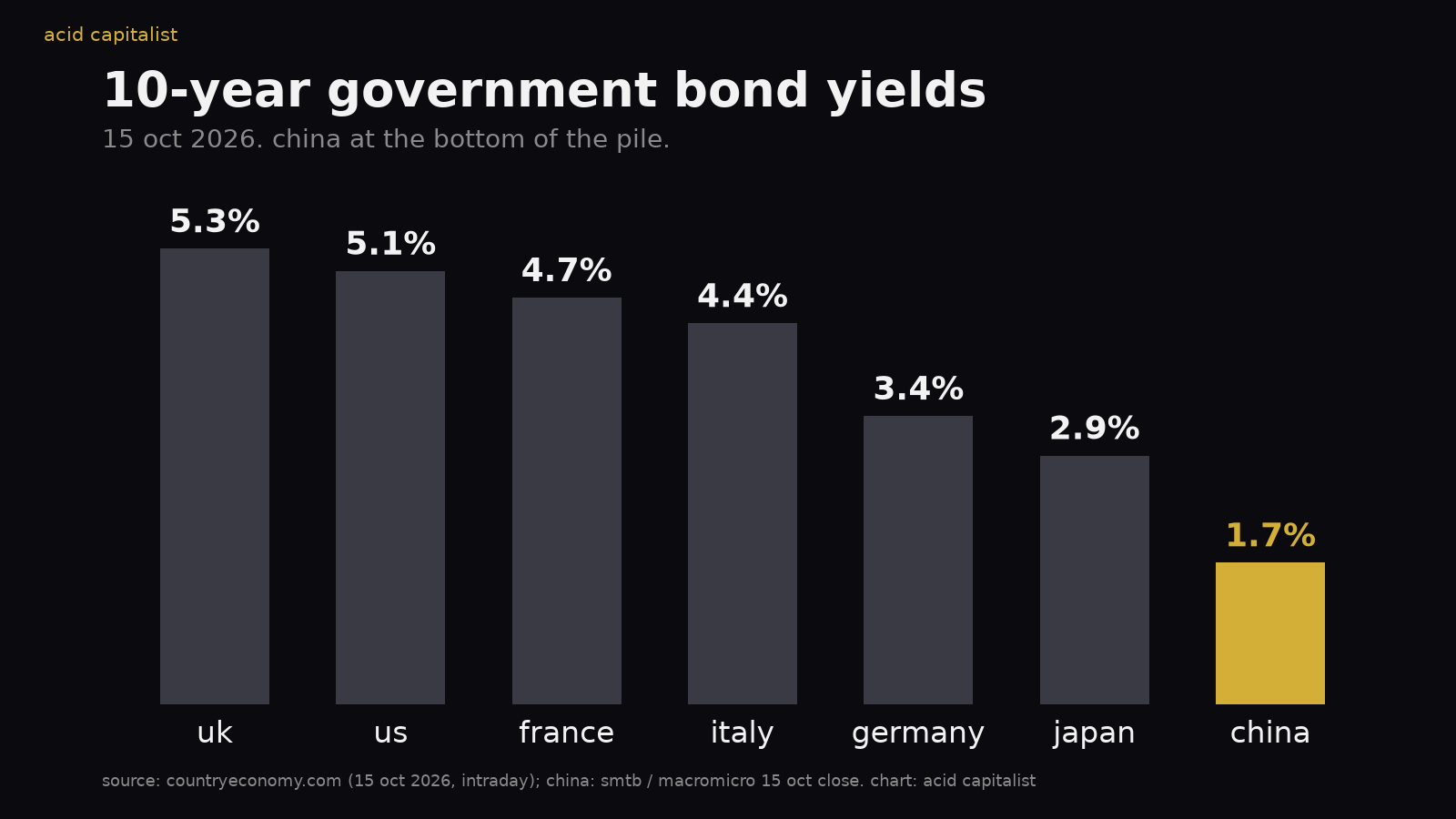
the whole tribe has its nose pressed against the american consumer price index, reading the decimals like entrails and waiting for a tenth of a point to tell us how frightened to be, while the real heat comes off a number almost nobody bothers to quote. china’s 10-year government bond yield sits barely above 1.6%, an extraordinary price for lending money to the greatest manufacturing machine the world has ever assembled.
america, meanwhile, pays a little over 5% for the same privilege. that’s quite a fucking difference. the western investor, encountering this peculiar divergence, might shrug and proceed to the next familiar ticker, blissfully unaware that they have just walked past the clearing price of an entire and gigantic national operating system, the one statement beijing makes that nobody, not even the communists, gets to edit. and the more i stare at it, the more uncomfortable i become, because the price that may matter most for america’s economic future isn’t american at all.
the operating system is simple enough once you stop expecting it to be reasonable.
china prioritises what i’d call arithmetically weighted gross domestic product growth, a tally that rewards the sheer volume of activity, along with the export capacity that keeps it climbing, and ranks both ahead of corporate profits and far ahead of household demand and wealth creation. the state subsidizes, the banks lend, local authorities compete to attract the next industrial champion and factories swarm and multiply until excess capacity spills out into the world at whatever price secures another slice of global market share. mercantilism on steroids, i call it, and profits be damned.
for decades this arrangement has been a formidable commercial proposition, satisfying a western appetite for cheap manufactured goods while creating an industrial colossus of almost unimaginable scale. but it has come at a peculiar domestic price. the chinese household has been required to finance much of this national political ambition through restrained income growth, financial repression and a banking system organized around the priorities of the producer rather than the consumer. state-forced savings, captive banks and capital controls; the architecture of a system in which the individual earns too little of the national dividend and is then expected to applaud the construction of another factory.
the result is a formidable machine that can’t easily change direction without questioning the arrangements that made it successful. when domestic consumers won’t spend, the central command’s answer has been more plant, as though you could cure a man’s lack of appetite by building him a bigger kitchen.
the new factory needs customers, the existing factory must lower prices to defend market share, and the banks financing both have every incentive to postpone the unpleasant business of recognising that the return on capital has become something of a national embarrassment. producers remain trapped in a competition they can’t afford to lose, even as their collective behaviour makes profitable production increasingly elusive.
what can’t be absorbed at home is pushed abroad, and the international market becomes the release valve for the pressure accumulating inside the chinese economy. beijing keeps throwing money at factories that produce more than its own people can afford to buy. the surplus gets shipped abroad, where it competes away everybody else’s profits. meanwhile, the chinese household is still waiting for its share of the economic miracle. some fucking miracle. because without a change in that fundamental distribution of income and spending power, the pressure has a nasty habit of returning in the form of falling prices.
and that’s what makes the chinese bond market so fascinating. government yields reflect all manner of influences, from central-bank policy and institutional demand to the regulatory peculiarities of domestic banks, but the long end of the curve also tells you something about the future investors are prepared to underwrite. in china that future is being discounted at a remarkably low rate, consistent with a world of subdued nominal growth, weak demand and inflation that seems reluctant to show its face.
the savings generated by the national operating system keep accumulating, while productive domestic opportunities capable of absorbing them at attractive returns remain depressingly elusive. so chinese money seeks safety, the banks accumulate government paper, and the yield on the safest long-term promises in the country stays close to the floor.
the bond market’s smarter than stocks, certainly smarter than me, and it worked this out long before much of the western commentary did. it has been repeating the diagnosis ever since, patiently, like a radiologist reading the same scan to a family that keeps asking about the miracle cure it saw on television. i would argue that china’s 10-year government bond yield is among the most important under-discussed variables on the global macro board, and it remains under-discussed partly because it is so unglamorous.
the miracle cure, apparently, was supposed to be equities. there was a fashionable belief a year ago that the chinese state could simply cherry-bomb the stock market higher, light the fuse and stand back while its national champions delivered a revival in animal spirits. the csi 300, the index of major companies listed in shanghai and shenzhen, traded recently around 4,166, more than 1,700 points beneath its 2021 high near 5,900 and still far removed from the exuberance regularly displayed by its american cousins.
policy support has generated rallies, certainly, and there are companies in china that can prosper despite the wider economic malaise, but the magnificent bullish declarations coming from international hedge funds a year ago have struggled to survive the subsequent disappointment. a government can sponsor liquidity, direct purchases and encourage the appearance of confidence, but the shareholder eventually requires evidence that the underlying companies can make money.
you can state bankroll a factory into existence, but seriously, you can’t subsidize a shareholder into believing he’ll ever earn an adequate return on capital. the bond market, meanwhile, has continued to entertain the possibility that the national income available to support those profits will remain inadequate. and i’d say, until the chinese 10-year starts challenging 2%, i’d treat every policy-sponsored equity rally as a rumour rather than a regime change. the bond market gets the casting vote.
this is where the linear, one-eyed crowd divides into its usual competing factions, one insisting that china is cheap and the other that it’s uninvestable, and they can keep that argument going for years because neither has noticed that the most interesting question is being asked in the wrong country.
the orthogonal move is to drop the argument about whether chinese equities work and follow the bill instead. one country’s current-account surplus must be matched by deficits elsewhere in the global accounts, and the accounting is merciless even when the political narrative isn’t. china produces a trillion dollars more than it consumes, sells the surplus abroad and accumulates financial claims on the rest of the world, directly or indirectly, through a financial system whose movements are considerably less visible than the container ships carrying the goods.
the money doesn’t necessarily travel straight from a chinese exporter into an american treasury bond, despite the tidy diagrams wall street’s teenage economists sometimes doodle to explain the process. it moves rather through banks, intermediaries, foreign asset markets and the immense offshore dollar system, where the original nationality of the savings can become rather difficult to recognise. but the claims must ultimately be held somewhere, and america has spent decades operating the largest and most seductive financial supermarket on earth. the goods move outward from china, the financial claims circulate through the global system, and the pressure eventually finds its way into the balance sheets of countries prepared to absorb more than they produce.
america is rather good at absorbing. its consumers possess an appetite for imported goods that has survived wars, recessions, political revolutions and the occasional theatrical promise from washington to restore national industrial greatness. its financial markets offer the rest of the world a remarkably deep reservoir of dollar assets, and its government has developed an extraordinary tolerance for borrowing even when the domestic economy is supposedly enjoying the benefits of an expansion. which is to say, the federal deficit is running at roughly 6% of gdp, a level that once might have suggested a recession or some other national emergency rather than the continuation of a historical economic boom.
and here’s the devil’s bargain. beijing builds the factories, keeps its households on a tight financial leash and ships the surplus abroad. the rest of the world gets the goods and somehow has to finance the appetite to consume them. america has been performing that trick for decades, swallowing imports and issuing dollar promises that foreigners have been only too delighted to own. an extraordinary arrangement, really.
the communists manufacture the merchandise, the capitalists manufacture the purchasing power, and both congratulate themselves on their economic genius. but the machinery depends upon an almost religious faith that the dollars will keep circulating, that foreign savings will find a home and nobody will seriously question the terms of the bargain. except, now washington is borrowing 6% of gdp in the middle of an expansion, tariff walls are going up, and the political consensus that once accommodated this curious division of labour is beginning to crack. the money still has to go somewhere. so do the goods. and i have an increasingly uncomfortable suspicion that we’ve spent thirty years mistaking the plumbing of an extraordinary historical arrangement for the natural order of the universe.
tariffs are beginning to wreck this bargain. america erects barriers to protect its factories and discovers that protection comes with a bill, while china’s extraordinary productive capacity remains stubbornly intact. the goods haven’t disappeared. nor has beijing’s desperation to sell them. we’ve spent decades constructing a global economy around china’s willingness to produce and america’s appetite to consume, and now the politicians are busily dismantling the arrangement without the faintest idea what happens to the money when the goods stop moving. that’s the part that keeps me awake.
i find this a considerably more disturbing development than another tenth of a percentage point increase in american consumer inflation because it concerns the architecture that has allowed the global economy to reconcile different national priorities for decades. the chinese state continues to favour the production of goods its households are reluctant to purchase, while america finds itself politically committed to protecting domestic employment and sustaining demand.
when washington looks at this devil’s bargain, between fiscal printing and mass layoffs, it has a predictable affection for the printing press, and i can’t bring myself to blame the poor bastards. its choices are not dictated by beijing, but they are being made inside a global system whose imbalances were partly manufactured there. the consequences increasingly appear in the most fundamental price in finance, the cost of borrowing money for a decade.
and i have to confess i do find myself returning, with increasing discomfort, to the closing years of the 1920s. france was hoarding gold with an almost pathological, serial-killer enthusiasm, its reserves more than doubling between 1926 and 1929, while american financial markets sucked in the world’s capital and germany was paying north of 7% to borrow.
the global monetary plumbing was beginning to seize. yesterday’s abundant credit was becoming tomorrow’s rather expensive absence, and the great trading nations were discovering that their financial arrangements had rather less give in them than anyone had imagined.
i’m not predicting a centenary crash. markets don’t give a fuck about anniversaries. but the lesson of 1929 is that international imbalances can appear perfectly sustainable until capital changes direction and the countries dependent upon its circulation discover that the exit has become remarkably narrow. the world still traded, the money still moved, and then, rather suddenly, it didn’t. look at the chart below.
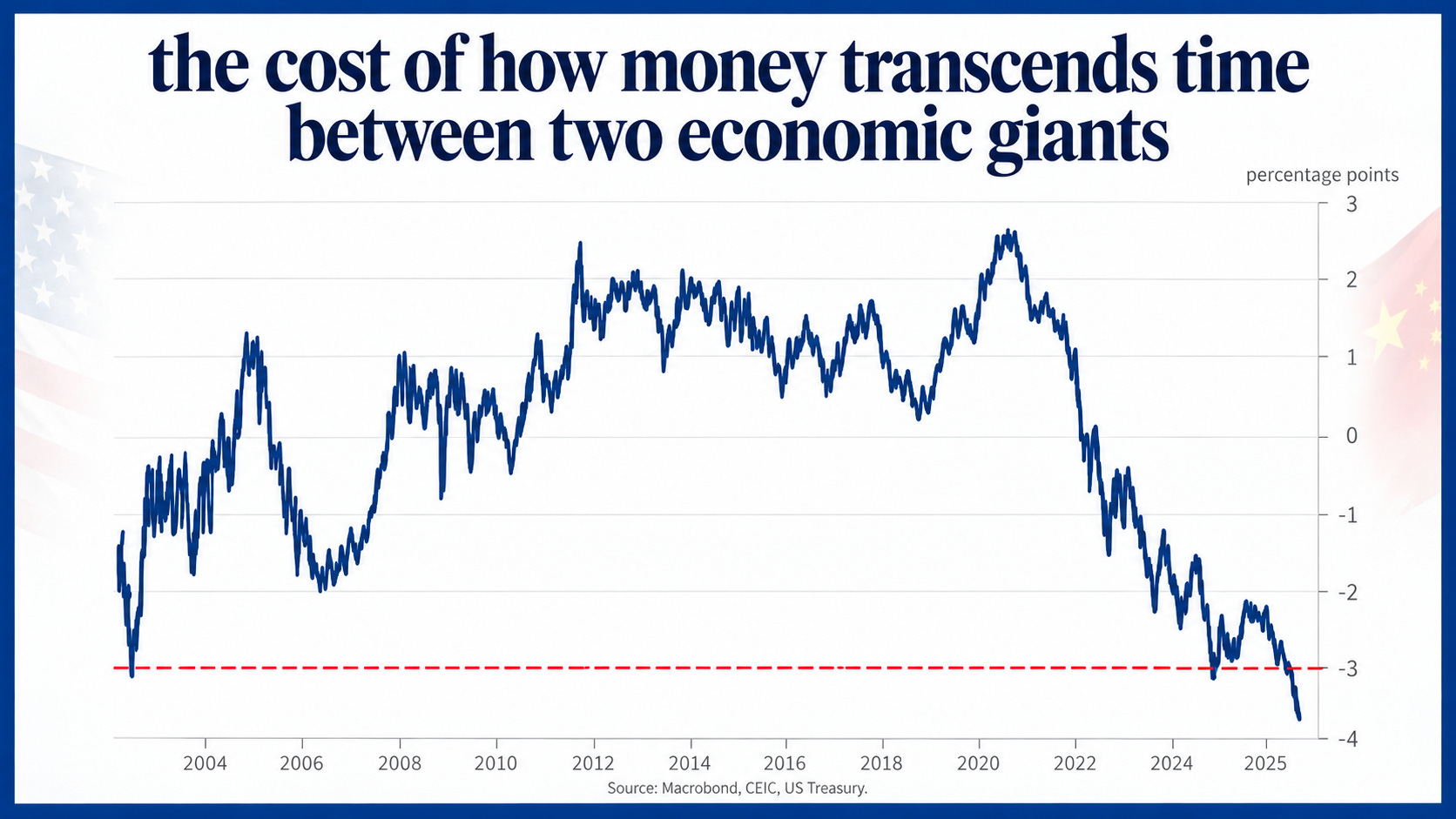
i’ve put the american and chinese 10-year yields on the same chart and the resulting picture is almost indecently alarming. america pays a little over 5.1%, china a little above 1.6%, leaving a gap of roughly 350 basis points between the day’s two great economic powers. for much of the past two decades china paid more than america to borrow at that maturity, a relationship that has now inverted with remarkable force.
the american bond market is wrestling with enormous government financing requirements, inflation uncertainty and the return investors demand for holding long-dated dollar promises. the chinese equivalent sits beneath the weight of savings and depressed domestic demand, as though the two economies belonged to different monetary civilisations despite being connected by one of the greatest trading relationships in human history.
i’ve spent enough of my life losing money to know that a chart doesn’t come with instructions. but this one has my attention. two economic giants, joined by the greatest manufacturing and consumption arrangement in history, now paying radically different prices for ten-year money. the divergence has become so extraordinary that i’m reminded of the old widow-maker, japan, and the succession of hedge fund geniuses who discovered that being right about an economic imbalance was no protection against getting absolutely murdered by its persistence.
the old widow-maker was an extraordinary education in the capacity of monetary arrangements to outlive the patience of the people trading against them. japan spent decades wrestling with weak nominal GDP growth and an economy that had become conditioned to very low interest rates, while successive generations of macro tourists convinced themselves that normalisation was just around the corner.
the poor blighters were repeatedly carried out on stretchers, their positions reduced to expensive tuition fees for the next cohort of optimists. by october 2023 the difference between american and japanese government bond yields had reached extraordinary proportions, with the long-standing divergence in monetary policy placing relentless pressure on the yen. then the bank of japan began changing the arrangements that had sustained the gap, culminating in the abandonment of negative interest rates and yield-curve control in march 2024.
japan eventually found the exit, although the yen had a good laugh at everybody’s expense before the adjustment took hold. the bank of japan finally began dismantling its monetary straitjacket, and the old widow-maker had to learn some new tricks. but at least there was a door. the japanese economy had begun generating the inflation and wage growth that gave its central bankers permission to move. now look across the sea to china. the factories keep multiplying, the households won’t spend and the bond market sits there at 1.6%, looking distinctly unimpressed. japan had a monetary problem it could eventually escape. beijing has built an entire economic religion around the very imbalance it needs to cure. good luck persuading the priests to close the church.
i demur. china doesn’t share japan’s starting point, and the temptation to assume that beijing merely needs to discover its equivalent of the bank of japan’s policy reversal strikes me as another example of the profession’s astonishing attachment to linear thinking.
japan needed to escape a monetary framework that had become increasingly inappropriate for the evolution of its domestic economy, whereas china’s problem lies deeper in the distribution of purchasing power and the priorities governing national production. the renminbi can be cheapened, interest rates can be lowered and the banking system can be instructed to produce another heroic expansion of credit, but none of those measures necessarily persuades a household frightened by its property wealth or uncertain about future income to consume the output of another industrial development.
cheapening the currency further might improve the competitiveness of the factories while making the international imbalance even more difficult to accommodate. but it makes the chinese household sector less inclined to consume. a reliable remedy would require a change in the relationship between the state, the producer and the consumer, a redistribution of national income that may be economically sensible but would question some of the foundations of the existing political model.
the mandarins are not fools. they know perfectly well that curing the imbalance would require surrendering some of the privileges that made their industrial miracle possible in the first place. and governments, rather like hedge fund managers, have a peculiar reluctance to abandon the arrangements that once made them look like geniuses. i understand the sentiment. the bond market, meanwhile, sits there at 1.6%, waiting for somebody to blink.
the centenary of october 1929 is now only three years away, and the anniversary frightens me more than almost anything else on the macro board. not because history operates to a calendar, or because i believe some supernatural clock is counting down toward another black thursday, but because the economic history preceding and following that catastrophe contains an appalling lesson about what happens when international trading arrangements cease to reconcile the interests of the countries dependent upon them.
perhaps china eventually finds the courage to redistribute enough of its national income to persuade its households to spend. perhaps washington discovers an appetite for fiscal restraint. i’d be delighted. i’ve been wrong about markets often enough to appreciate their extraordinary capacity to prolong arrangements that ought, by any reasonable measure, to have expired years earlier. but the longer i stare at this particular scoreboard, the less comfort i derive from that possibility. the chinese 10-year is still hovering around 1.6%, america is paying above 5%, and tariff walls are rising between two countries that have spent decades becoming grotesquely dependent upon one another. the money must keep moving. so must the goods. and increasingly, the politicians seem determined to make both propositions rather more difficult.
there are respectable people on wall street presently devoting extraordinary energy to the wisdom supposedly concealed inside credit default swaps on the hyperscalers and their assorted proxies. more on that little circus another time. i’m rather more interested in what happens when the world’s great manufacturing surplus encounters a financial system increasingly reluctant to accommodate it. the world of 1929 did not collapse because somebody noticed an anniversary approaching. it collapsed after an international economic arrangement proved incapable of absorbing the pressures building inside it. i can’t name a date and i’d distrust anyone who claimed to. but i recognise the smell of an arrangement that has begun to outlive its usefulness, and i don’t much care for it. tomorrow the wall street commentariat will return to trembling before another tenth of a percentage point in american inflation. me? i’ll be watching the quieter scoreboard in beijing, still hovering a little above 1.6%, patiently counting a game that much of the global macro hedge fund community doesn’t even realise it’s playing.
hugh 🏴☠️ 🌴

tomorrow the street will resume its usual trembling over another tenth of a point. i shan’t.
for thirty years i managed other people’s money, fifteen of them with an audited hedge fund record, at one point responsible for nearly two billion dollars belonging to clients who were not interested in excuses. it was an expensive education. occasionally glorious, frequently humiliating, and it taught me to look where the crowd isn’t.
i can’t give you a formula. what i can offer is the benefit of those thirty years, the mistakes already paid for, the occasional triumph, and a way of thinking about money that rarely begins where the consensus does.
the free postcards will keep coming. but if you’d rather learn to think about markets from somewhere other than the middle of the herd, come inside.
become a paid subscriber
joy is our energy.
Hx