

a small warning from the writer.
i’m really not sure what happened. on friday morning i was trying to make an instagram reel about non-farm payrolls. by friday night this paper had appeared in my imagination and was refusing to leave. then it rained all weekend. i spent an unreasonable amount of time in bed, swallowed more gummies than was probably useful to monetary history, and kept turning the same idea over until it began answering back.
somewhere in there i realised this paper feels as though it took me 10 years to write. perhaps it did. i’ve spent most of my adult life trying to make money from things that weren’t yet obvious, which has left me with a fairly low opinion of opinions. everybody has them. the money is in seeing something early enough to be lonely, then having enough character to stay with it without becoming so attached that you can no longer recognise when you’re wrong.
that is more or less the mission here.
this paper is certainly too long, and there are places where i’m asking you to hold several ideas in your head while i work out whether they really belong together. so don’t read it like a post. read it like a long chapter of a book. take it slowly. put it down and come back. turn the statue around a few times.
i think there’s something here. i’m less certain that every part of it is right. that distinction matters to me. the older i get, the less interested i am in being agreed with and the more interested i am in finding the thing i haven’t seen.
so ask me questions. tell me where the argument breaks. if i’ve confused correlation with causality, say so. i hope we can fall out politely. disagreement, properly conducted, is one of the few remaining forms of intellectual generosity.
and if you make it to the end, you may discover that this isn’t really a paper about china at all. it is a celebration of charles kindleberger. it’s about money, creditors and what happens when the world keeps sending its savings to the place least willing to send them back.
preface.
in 1929 america was the world’s great creditor. today it’s china. forget the crash. the interesting bit came afterwards.
1931–34.
that was when the monetary system started choosing its victims.
i think we’ve been looking at the wrong years.
hugh.
in three years’ time, 1929 will be a hundred years old. that’s part of the problem. look at the photographs. it’s already archaeological: men in bowler hats outside marble banks, ticker tape drifting through the frame. the whole thing belongs to a world so abstract that we can study it without ever believing it could happen to us. but monetary systems don’t care about costumes. the plumbing survives long after the photographs start looking quaint.
and these past few days, i’ve been staring at the american bond market from the landing stage of the late 1920s, trying to understand if china’s government bonds are doing something similar today. and i’m beginning to suspect that 1929 may be the wrong year altogether. perhaps i should be studying the entrails of 1931-34.
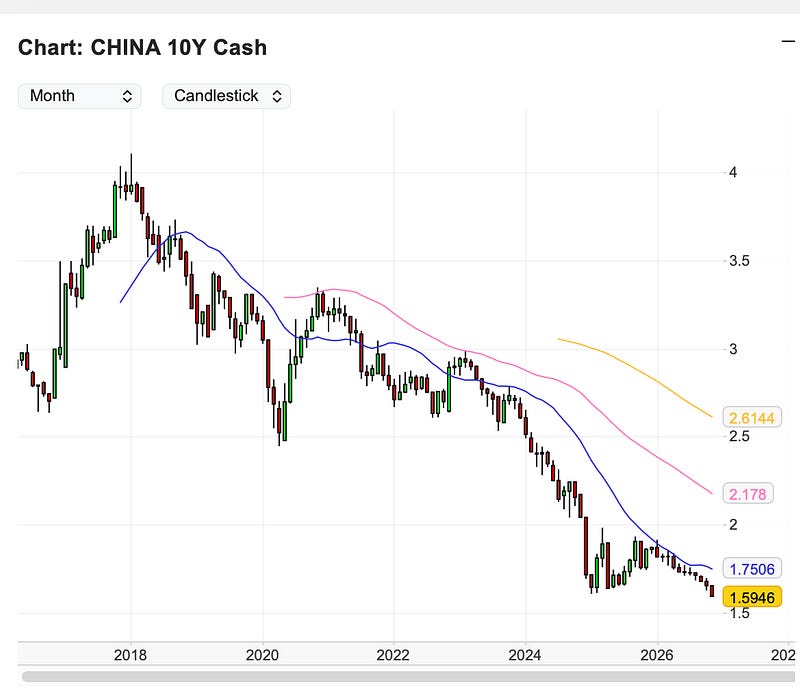
you see, i’ve spent much of my life in the future, spent too much damn time actually there trying to imagine what hasn’t happened yet. and history is really good at encouraging me to use the argument i already wanted to make. take two charts. maybe it’s the ten year us note from the 1920s and the chinese government’s modern equivalent. both can look uncannily alike and still be telling you completely different things. i learned that the expensive way.
history can rhyme until the wallpaper peels off. i only care when the thing that can’t move starts behaving the same way.
america in the 1920s was china today. not in its politics or its institutions, but in its relationship with the rest of the world. america was a great industrial creditor, accumulating international surpluses while debtor nations struggled to find the money to pay for them. the monetary system allowed the americans to keep that advantage for far longer than common sense should have permitted. and then the french entered the fray. the bloody french.
modern china has inherited the same role too. its annual goods-trade surplus is now above $1 trillion, roughly 1% of global annual economic output. not 1% of chinese gdp. 1% of the world. and the remarkable thing is that the global political system continues to accommodate it. it’s rarely discussed.
normally the surplus should contain the seeds of its own destruction. china sells more to the world than it buys in return, so chinese claims accumulate at home and their currency should rise. that makes imports cheaper for chinese households and transfers purchasing power back towards the consumer. it’s a very elegant system: the creditor becomes richer in global terms, which is exactly how the imbalance is supposed to start correcting itself from within.
that mechanism is the market’s way of refusing to let one side win forever. but it only works if the price is allowed to move and the claims are allowed to become purchasing power. keep the currency weak enough and the capital account closed tight, and the transfer never really happens. the trade surplus keeps compounding, the household stays relatively poor in global terms, and the adjustment is pushed back onto everybody else.
bunch of kunst.
in the 1920s america accumulated gold, the ultimate international settlement asset. under the gold standard, those inflows should have expanded domestic money and encouraged higher prices, pushing the adjustment back through the american economy. but a hard money fed increasingly interrupted that mechanism by sterilising part of the gold inflow. when this form of high powered money arrived from overseas, the feds refused to let the money supply expand with it. economists call that sterilisation. i call it taking the punch out of the punch bowl before anyone has had a drink.
bunch of kunst.
france did something altogether more audacious with its gold. they’d watched churchill’s disastrous attempt to restore the british pound at its old pre-war gold parity and taken the opposite lesson. they stabilised the franc at a fraction of its former gold value, and in 1928 they made that 80% devaluation official. the trick was now to prevent all that gold pouring in, from producing the domestic monetary expansion that had previously derailed the french economy. road blocks were designed to prevent the sort of macro reaction that the international trade system had been designed for. in theory, france’s fresh gold transfers should have boosted the country’s nominal gdp to the benefit of all its trading partners. instead, france kept the competitive currency for itself and sterilized the settlement asset. the adjustment mechanism never stood a chance.
bunch of kunst.
the creditor nations of the 1920s refused to adjust, so the debtors were forced to.
in recap: britain maddeningly restored sterling at the old pre-war price of $4.86 and then spent the rest of the decade forcing the domestic economy to live with it. france did the opposite. they returned with an absurdly cheap franc and discovered that investors rather liked owning a currency they believed could appreciate.
gold flowed towards paris while britain struggled to hold on to its own.
the country trying hardest to prove its currency was strong kept having to defend it. the country that had admitted its currency was weak became the one everybody wanted to own.
germany was where the arithmetic became swashbuckling. after the hyperinflation, the dawes plan stabilised the reichsmark, but germany still had to transfer reparations abroad and that meant finding hard money. wall street was initially obliging and germany became heavily dependent on american capital.
the machine worked beautifully right up until america stopped feeding it dollars.
by 1929 the fed discount rate was 6%, up from 4% the year before, and the money that had been financing central europe suddenly remembered where home was. american capital came back hard. the foreign lending that had kept germany upright began disappearing before wall street had even finished blowing itself up. that’s the ugly little rule underneath international finance: the dollars are yours right up until the man who lent them decides they’re his again.
france made the whole thing stranger still. sterilising the gold at home was only half their fiendish trick. french wealth was free to travel beyond its border, and with domestic yields crushed it went hunting for return in new york, where call money had touched 20%. the fed was leaning on american banks to curb the stock lending it blamed for feeding the price bubble. but the money simply changed clothes. american banks were replaced by overseas banks stock lending and the party continued.
with foreign lenders like the french and other grand european rentiers stepping into the funding space on wall street, the fed tightened harder. and eventually the tighter dollar policy came ricocheting back across the atlantic onto the very economies already desperate for capital. france had interrupted the gold adjustment at home, then helped finance the fever abroad. the french black hole had started exporting consequences.
funding problems rarely disappear, of course. they’re not exclusive to a particular era. modern day turkey still needs roughly $286 billion of external financing, while oracle has just been forced to raise 5-year money at roughly 7.5%, about the same price as turkey. that doesn’t make oracle turkey. but it does tell you dollar credit is getting more expensive, everywhere.
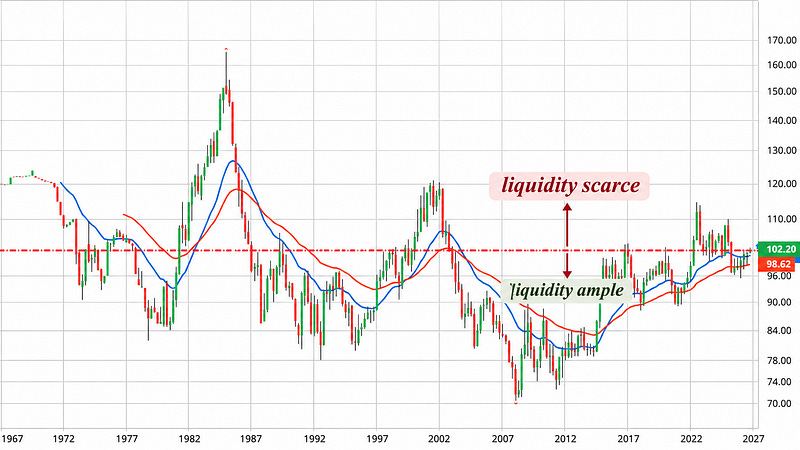
now i’ve always thought youtube talks about macro liquidity measures are nauseatingly cheap. for fuck’s sake, if you’re concerned about liquidity, watch the dollar. so much credit outside america is created in greenbacks while the income supporting it is earned in something else that when the dollar rises, yesterday’s manageable balance sheet simply gets heavier. there’s economic logic to why the dollar index largely trades below one hundred.
wanna save $3,750? take the suite in my house on st barts. or save $2,250 in the villa next door. or just save $750 and bring your wife.
summer camp 5.0, 1 to 6 august 2027.
those prices die on 1 january. book before 31 december.
come to next years’s summer camp. hugh 🏴☠️🌴